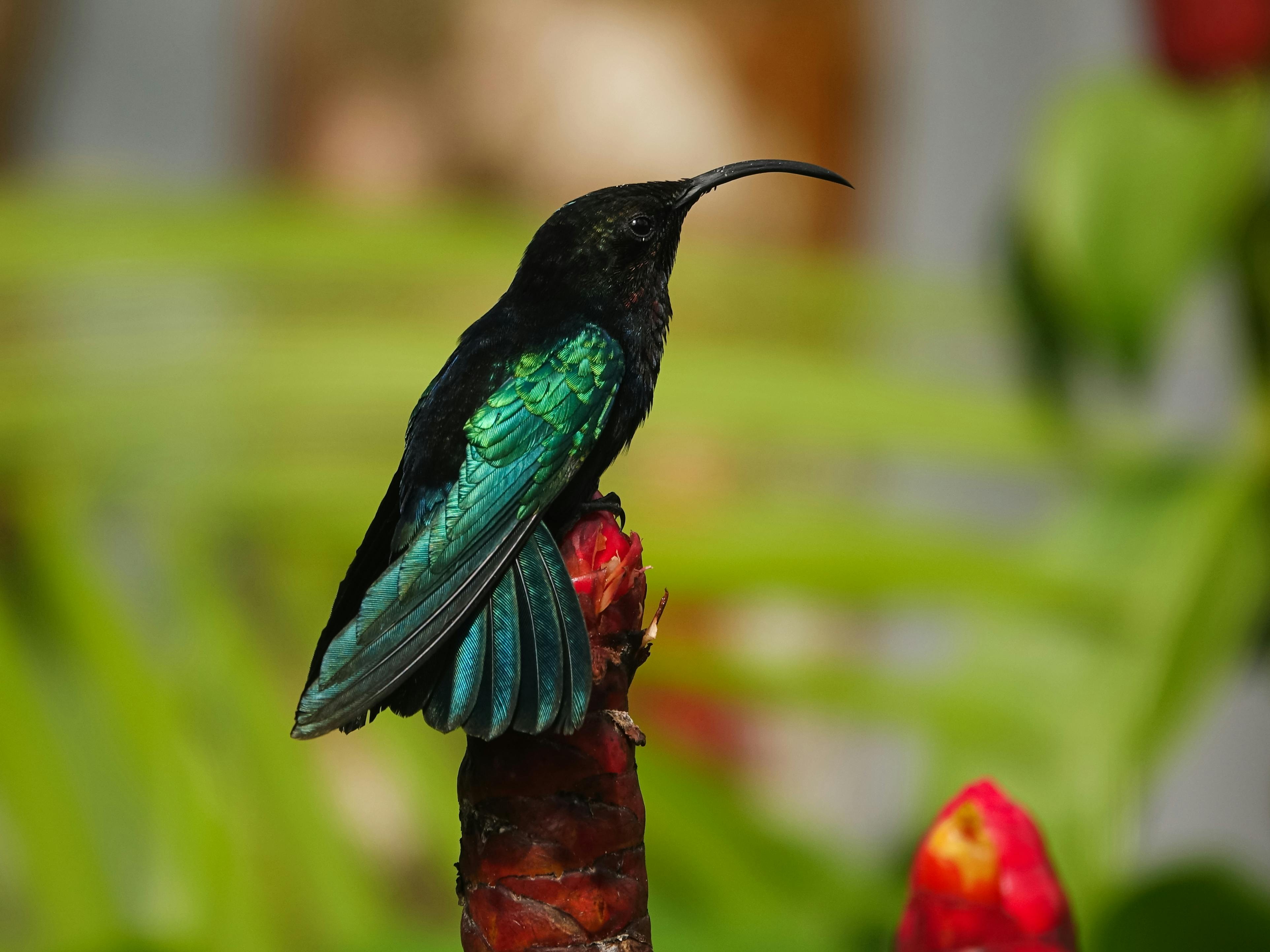
Blue-headed hummingbird on the slopes of Mount Pelée, Northern Martinique

Hummingbirds and Birds of Martinique: an Amerindian Name, a Heritage of the North

A symbol of Martinique, the hummingbird carries within it a piece of the island’s oldest history: its very name is thought to come from the first Amerindian inhabitants. On the slopes of Mount Pelée, in the Northern Caribbean, several species of hummingbird and endemic bird find refuge today in an unspoiled natural setting. This natural heritage sits alongside other heritage of the North that Smartinik brings to life, such as Mount Pelée itself.

“Hummingbird”, a word from the “Savages” of Martinique

It is in Martinique that the word “colibri” (hummingbird) first appears in written form. In 1640, in his “Relation de l’establissement des François depuis l’an 1635 en l’isle de la Martinique”, the Jesuit father Jacques Bouton describes this small bird with its dazzling plumage, which feeds on flowers just like bees: “we call them colibry, it is the word of the Savages, which means bird, which we have particularly applied to this one”.

The word is thus presented as an indigenous term, simply meaning “bird” in the language of the island’s first inhabitants. Its precise origin, whether Carib, Galibi or otherwise, has however never been formally established by linguists, and remains uncertain to this day. What is certain, on the other hand, is that this name, born in Martinique, went on to spread throughout the French language to designate this family of American birds.

Four hummingbirds unique to Martinique

Four hummingbird species live in Martinique. The crested hummingbird, locally called “Foufou”, is the smallest: barely 8 cm long and weighing just 2 to 3 grams. The male is distinguished by his crest, absent in the female.

The purple-throated carib, endemic to the Lesser Antilles, measures between 11 and 12 cm: male and female look alike. The green-throated carib completes this family of tireless foragers.

The blue-headed hummingbird, finally, is the rarest of the four: endemic to Martinique and Dominica alone, it measures 11.4 cm and lives in humid forests from 300 metres of altitude upward. In this species, male and female differ markedly: the female has a whitish-grey underside, while the male sports a predominantly green plumage with bluish hues, with a metallic royal-blue head and tail.

The blue-headed hummingbird, star of Mount Pelée's slopes

It is precisely in the North of Martinique that this rare hummingbird is most easily observed: it can readily be seen on the Mount Pelée and Pitons du Carbet massifs, where the humid, high-altitude forests provide it with an ideal habitat.

The Mount Pelée Integral Biological Reserve, a sanctuary of the North

Created by inter-ministerial order on 28 April 2007, the Mount Pelée Integral Biological Reserve (RBI) covers 2,301 hectares, straddling four communes of the North: Morne-Rouge, Le Prêcheur, Grand-Rivière and Basse-Pointe. Managed by the National Forestry Office (ONF), it comprises seven distinct types of forest formations.

As part of efforts to study the fauna and flora of this area, the association Le Carouge was commissioned by the ONF, with co-funding from the Directorate for the Environment, Planning and Housing (DEAL), to carry out a survey of the birdlife. This work identified 26 bird species across 11 different families, 9 of which are endemic to the Lesser or Greater Antilles. Among the species recorded during this survey are all four of Martinique’s hummingbirds, as well as the rufous-throated solitaire, the forest thrush and the Caribbean elaenia.

Discover the North's hummingbirds and birds with Smartinik

Morne-Rouge, Le Prêcheur, Grand-Rivière and Basse-Pointe, the communes of the Mount Pelée Integral Biological Reserve, lie within the same Northern territory as the guided tour of Saint-Pierre and the Northern Martinique excursion offered by Smartinik.

Smartinik enriches its tours with explanations of this unique birdlife heritage, its Amerindian origins, and its preservation by local stakeholders of the territory.

  • Amerindian origin of the word hummingbird, documented in Martinique as early as 1640;
  • the four hummingbird species and their distinctive features;
  • birdlife of the Mount Pelée Integral Biological Reserve;
  • the link between the North’s terrain and the presence of rare endemic species.

Smartinik does not systematically organise a birdwatching outing dedicated to observing the North’s hummingbirds and birds: this possibility depends on the season and conditions.

Contact Smartinik

Experience Martinique differently!

Frequently asked questions about Northern Martinique's hummingbirds

The word colibri (then spelled colibry) first appears in 1640, in Martinique, under the pen of the Jesuit Jacques Bouton, who presents it as a word of the “Savages” meaning “bird”.

Four species live in Martinique: the crested hummingbird (Foufou), the purple-throated carib, the green-throated carib and the blue-headed hummingbird.

The blue-headed hummingbird, endemic to Martinique and Dominica, is easily observed on the Mount Pelée and Pitons du Carbet massifs.

Created in 2007, this 2,301-hectare reserve spans the communes of Morne-Rouge, Le Prêcheur, Grand-Rivière and Basse-Pointe. A survey there recorded 26 bird species, 9 of which are endemic to the Lesser or Greater Antilles.

Our guarantees

Atout France

Atout France

Travel operator registration IM972260001.

APST

APST financial guarantee

Financial protection appropriate for a registered travel operator.

Hiscox

Hiscox insurance

Professional liability insurance covering the services offered.

Follow us!

Contact us